

What Frequencies Are Assigned To The Commercial Land Service
Full general principles and features of Maritime Mobile Service
Priorities of communication in the maritime mobile service
Article 53 of the International Telecommunication Union Radio Regulations states that all stations in the Maritime Mobile and the Maritime Mobile-Satellite service shall be capable of offering four levels of priority in the following order:
Distress
A distress bulletin indicates that a mobile unit or person is threatened by grave and imminent danger, and requires firsthand assistance.
A distress message has accented priority over all other communications.
• Distress calls transmitted by radiotelephony are prefixed by the discussion 'MAYDAY' sent three times. Subsequent messages are preceded by the word MAYDAY once just (refer to Department fourteen.7.two).
Urgency
An urgency message indicates that the calling station has a very urgent bulletin concerning the safety of a mobile unit or person.
An urgency bulletin has priority over all other communications, excepting distress.
Urgency letters transmitted via radiotelephony are prefixed by the words 'PAN PAN' sent 3 times.
Condom
A safety message indicates that the calling station has an important navigational or meteorological warning to transmit.
A safety bulletin has priority over all other communications, excepting distress and urgency.
Safety messages sent via radiotelephony are prefixed by the word 'SECURITE' sent iii times.
Routine/public correspondence (Other)
A routine bulletin is i not covered past the previous categories. Public Correspondence communications are those which are used to convey routine information between persons on board vessels and those aground through the public telecommunications network. Examples of Public Correspondence communications are: telephone, fax, electronic mail and data messages.
Types of stations in the Maritime Mobile Service
Ship stations
A send station is a radio station established on board a vessel for communications with stations ashore and other ship stations.
Coastal radio stations
A coast radio station is a radio station established on country for the purpose of communicating with ships at bounding main.
There are typically two types of coast radio stations:
- Major Coast Station - a station whose major function is the transmission and reception of messages on behalf of the public and also provides GMDSS distress and condom services.
- Limited Declension Station - a station whose major function does not include the handling of messages of a public correspondence nature (encounter ii.i.4). These stations practice not provide GMDSS distress and prophylactic services, and are often operated by volunteer organisations, some State and Territory Government entities and individual or commercial entities.
Port operations stations
Port operations stations are established for the operational control of ships in and around ports and harbours. They are also known every bit "Harbour Control" stations. Some of these stations are classified as Vessel Traffic Service (VTS) stations as defined by the International Maritime Organization (IMO) Resolution A.857(xx).
Shipping stations
Send stations communicate with aircraft stations during search and rescue operations on designated frequencies.
Rescue Coordination Middle (RCC)
The RCC coordinates search and rescue operations for ships and aircraft and the promulgation of navigation warning information (referred to as Maritime Safety Data - MSI). An RCC is connected by various communications links to declension radio stations, land globe stations and other search and rescue organisations.
Frequencies and Frequency bands
The number of times that the alternating current in a radio wave performs its complete cycle per 2d is known as its frequency. The international unit of measurement of frequency is the hertz (abbreviated - Hz).
The wavelength of a radio wave is the distance between 2 successive positive peaks of 2 cycles. Wavelength is inversely proportional to frequency, i.e. every bit the frequency of a radio wave increases, the wavelength decreases, and vice-versa.
The wavelength of a radio moving ridge is determined past the formula:
wavelength (m) = velocity in metres (k)s per second (s) divided by frequency in hertz (Hz).
The velocity of a radio wave is a constant 300 000 000 m per second.
Units of frequency
Units of frequency are:
The kilohertz (kHz) = 1 000 hertz
The megahertz (MHz) = 1 000 000 hertz
The gigahertz (GHz) = 1 000 000 000 hertz
Sub-sectionalisation of the radio frequency spectrum
The radio frequency spectrum is sub-divided into
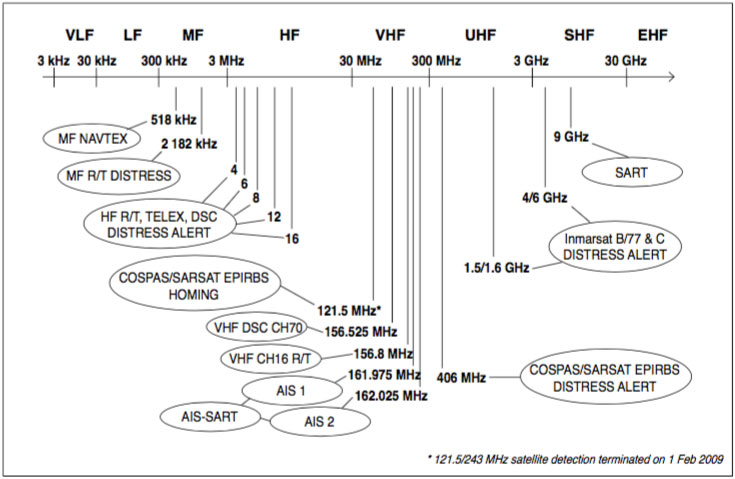
Figure 2 - ITU radio frequency bands and GMDSS usage eight bands, as follows:
Very Low Frequencies (VLF) three to 30 kHz
Low Frequencies (LF) 30 to 300 kHz
Medium Frequencies (MF) 300 to three 000 kHz
High Frequencies (HF) 3 to 30 MHz
Very High Frequencies (VHF) 30 to 300 MHz
Ultra High Frequencies (UHF) 300 to iii 000 MHz
Super Loftier Frequencies (SHF) 3 to 30 GHz
Extra High Frequencies (EHF) thirty to 300 GHz
Frequencies allocated to the Maritime Mobile Service
The International Telecommunication Wedlock (ITU) has allocated various bands of frequencies throughout the radio frequency spectrum to the Maritime Mobile Service and the Maritime Mobile-Satellite Service.
The bands and their uses are detailed in Figure.
Simplex and duplex channels
All HF and all VHF marine frequencies are arranged in a channelised format.
Channels are designated as either:
Simplex – operating method in which transmission is made possible alternatively in each direction of a telecommunication channel, for example, past means of manual (see unmarried frequency); or
Duplex – operating method in which transmission is possible simultaneously in both directions of a telecommunications channel.
Simplex performance
A simplex arrangement allows only 1 station to transmit at any one time. Communications equipment designed for simplex performance uses ane antenna, which is connected to either the transmitter or the receiver through a change-over relay or switch.
Channels used for distress and calling purposes are ever operated in simplex mode, and so that all stations tin hear all others using the frequency.
Duplex operation
Communications equipment designed for duplex operation allows simultaneous transmission and reception on two different frequencies through the utilise of either two widely spaced antennas or ane antenna connected to the transmitter and receiver through special combining and filtering circuitry.
Duplex channels are commonly used for public correspondence purposes (i.eastward. radio telephone calls). Each duplex channel comprises two separate frequencies - one for transmit and i for receive.
Duplex operation allows radiotelephone calls to and from suitably equipped vessels and coast radio stations to be conducted in the aforementioned way as telephone calls fabricated over the conventional country telephone system - i.east. both parties tin can speak and be heard at the aforementioned fourth dimension.
Only two stations tin use a duplex aqueduct at whatsoever 1 time.
Semi-duplex functioning
Communications equipment that does non have the facility for simultaneous transmission and reception oft operates in 'semi-duplex' manner - i.due east. a method which is simplex performance at ane finish of the circuit and duplex operation at the other.
HF Radiotelephone Channel Program
The HF radiotelephone aqueduct plan is described in Appendix 17 of the ITU Radio Regulations, and reproduced in the Manual for use by the Maritime Mobile and Maritime Mobile-Satellite Services (carried by every GMDSS ship).
The programme allocates a series of channels for duplex functioning, and a series of channels for simplex (inter- send) operation. Duplex channels are always referred to by their channel number. This aqueduct number is comprised of iii or 4 digits, the first i or two representing the frequency band (four, 6, viii, 12, 16, 22 and 26 MHz), and the concluding ii representing the actual channel number, i.e. aqueduct 403 is the third channel in the 4 MHz ring, and channel 1602 is the 2nd channel in the 16 MHz ring.
Appendix 17 (as per the 2011 edition of the Transmission for use by the Maritime Mobile and Maritime Mobile- Satellite Services) lists both the simplex and duplex channels bachelor in the 4 to 26 MHz range. As a result of the introduction of GMDSS, and the move to satellite-based communications methods, these sub-bands have become nether-utilized, and with full international agreement, new digital technologies are expected to be introduced into these bands. Each country is allocated a number of channels from each band for apply past its declension and ship stations.
VHF radiotelephone aqueduct programme
The VHF aqueduct plan equally described in Appendix 18 of the ITU Radio Regulations, and reproduced in the Transmission for utilise by the Maritime Mobile and Maritime Mobile-Satellite Services (carried by every ship using the GMDSS), and is provided in Appendix 10 of the Handbook. The Radio Regulations Appendix 18 was updated at ITU WRC-12, and while the GMDSS channels are unchanged, new single-frequency channels accept been created, and more than exibility exists for new digital channels, too as channels for testing of new technologies. Some of these changes volition come into due east ect from 1 January 2017 and administrations are evaluating how the new channels are to be used locally, and in that location are some regional variations for the new digital channels. The remarks below refer to the new aqueduct plan.
A total of 68 VHF channels are available in the VHF channel programme. Of these at to the lowest degree 65 are expected to exist selectable by the user, but additional channels could be bachelor depending on the manufacturer programming, since a number of channels can be operated in unmarried-frequency or two-frequency mode under diverse Appendix xviii Notes.
A new channel 2006 has been designated for experimental use for time to come applications or systems (e.g. new AIS applications, man overboard systems, etc.) – if authorised by administrations. Now, no equipment tin can monitor this channel, but new equipment may. The eventual usage of this aqueduct in reality is nonetheless to be determined.
Four digit channel numbering
It will be noted that the channel plan at present includes four-digit channel numbering for certain channels. Equipment manufacturers are examining how this will exist incorporated into their equipment. It is based on Recommendation ITU-R Thousand.1084-4 Addendum four, which adds the "10" pre ten to a unmarried-frequency channel number, if a 2-frequency channel is operated in single-frequency mode using the ship transmit frequency. Alternatively, the "xx" pre ten is added to a unmarried-frequency channel number, if a two-frequency channel is operated in unmarried-frequency style using coast station frequency.
Two channels are exclusively for AIS (AIS 1 and AIS 2) and one is exclusively for DSC (Channel 70). Each simplex and duplex channel is assigned a speci c purpose by the ITU. Nevertheless while the entire list is contained inside the Transmission for use by the Maritime Mobile and Maritime Mobile Satellite Services speci cally notation the following:
Channel 06: may be employed for communication between send stations and aircraft stations engaged in co-ordinated SAR operations and ship stations should avoid harmful interference on this aqueduct.
Channel 13: is designated worldwide as a navigation safety advice aqueduct primarily for inter-send navigation safety communications.
Channel xvi: may only be employed for Distress, Urgency, Safe and Calling.
Channels xv and 17: may be used for on board communications provided the radiated power does not exceed 1 W (low power setting) and such communications are permitted in the waters of the coastal state in which the ship is operating.
Channel 70: is used for Digital Selective Calling for Distress, Safety and calling.
Channels 75 and 76: should be restricted to navigation related communications and as these channels are located in the band either side of aqueduct 16 (see Appendix ten). Measures should exist taken to minimize the risk of harmful interference on that channel such equally using low power (1 Westward). At WRC-12, information technology was agreed that these channels shall also be used to enhance the satellite detection of AIS transmissions from ships. New AIS Grade-A and Class-B "SO" transceivers tted with this capability, will automatically transmit a special AIS Bulletin 27 which can be detected by satellite, alternatively on channels 75 and 76 (at 12.five watts) every 3 minutes, when outside VHF coverage of a terrestrial AIS base station. These transmissions are non expected to cause interference to channel xvi.
The frequencies of 161.965 MHz and 162.025 MHz are known every bit AIS 1 and AIS ii and are used exclusively for AIS.
Each country determines their ain individual channel allocations, based on the ITU guidelines. The band is extensively used past ship, littoral, limited coastal and port operations stations world-broad.
HF Narrow Band Direct Press (Radio Telex) channel plan
The HF Narrow Band Direct Printing (NBDP - also known equally 'Radio Telex') aqueduct program is described in Appendix 17, Section Iii of the ITU Radio Regulations.
Commercial HF NBDP channels are assigned in a similar way to duplex radiotelephone channels. Each channel consists of 2 frequencies, one for the ship and one for the coast station.
Every bit a issue of WRC-12, the Radio Regulations contains two versions of Appendix 17, 1 which will remain in force until 31 Dec 2016 and one which will come into forcefulness from 1 January 2017. The latter one will have a reduced number of channels bachelor for non- GMDSS NBDP and Morse telegraphy, just an increased number of channels for new digitally-modulated emissions, which besides provide for the combining of channels into wider blocks for larger data rates.
While NBDP or TOR (Telex over Radio) has been in sharp decline over a number of years equally a commercial service, a new method of text communications has been adult using the same spectrum. This new system which allows the utilise of electronic mail over the terrestrial (HF) bands has been developed as a global network, but does non class part of the GMDSS.
GMDSS distress and prophylactic frequencies
The ITU has allocated simplex (i.e. unmarried frequency) frequencies in the MF, the VHF and each of the HF maritime bands exclusively for distress and safety purposes. These frequencies are protected past international agreement, and whatsoever transmission capable of causing harmful interference to distress and safety signals is prohibited.
Component parts of Marine Radio Equipment
The major parts of radio equipment
Marine radio equipment, whether operating in the VHF or MF/HF bands, is fabricated upwardly of three major sections:
- The antenna or aerial;
- The transmitter and the receiver, and
- The power supply. Each part is dependent on the other. A fault in any i of the parts will not allow the equipment to function correctly.
The antenna
The antenna has two functions: • During transmission, to radiate into space the radio frequency energy generated by the transmitter; and • During reception, to gather radio frequency free energy from infinite and pass it to the receiver. The antenna, therefore, is continued to either the transmitter or the receiver, depending whether transmission or reception is taking place.
The changeover is controlled by the 'press to talk' switch or button on the microphone or handset. When pressed, the transmitter is turned on and the antenna is connected to it. When released, the transmitter is turned o and the antenna is re-connected to the receiver.
On MF/HF transceivers, to achieve effective communications, information technology is essential to provide an "earth" to the water surrounding the vessel. Usually, this is achieved by running a heavy at copper strip from the earth terminal of the transceiver to part of the metallic superstructure.
The transmitter and the receiver
The function of the transmitter is to turn voice (audio) or data signals into a form where they tin can travel over very long distances. This is achieved past converting vocalization signals spoken into the microphone or data signals presented to the transmitter into high powered radio frequency energy which is passed to the antenna and radiated every bit ground and sky waves.
The part of the receiver is to select only those radio frequency signals which are required past the operator and amplify them. These signals are then converted back into voice or data signals and reproduced past a loudspeaker or fed to a data device.
It is usual with marine radio equipment for the transmitter and receiver to be combined in a single unit chosen a transceiver.
The ability supply
The office of the ability supply is to supply electrical free energy to the transmitter and the receiver to enable them to acquit out their tasks.
Fuses located in the wiring between the ability supply and the transceiver protect the equipment against damage should a malfunction occur.
Modes of communications
Marine radio equipment uses diverse modes of emission for di erent functions. These modes can be summarised as follows:
radiotelephone - the most common mode of operation. In this mode, voice signals are transmitted over a radio link using various forms of modulation (see below).
Narrow band Straight printing (NbDp) - telex signals are transmitted over radio.
Digital Selective Calling (DSC) - A paging organization that uses information signals to automate the manual of distress, urgency or condom calls via MF, HF or VHF radio.
Every bit outlined in Section 2.four.half-dozen, the ITU has allocated a speci c frequency in the MF, each of the HF and the VHF marine bands for distress and safety tra c via each of these three modes of operation.
Radiotelephone
In this system, at the transmitter, audio (voice) signals are modulated (or combined) with a radio frequency signal - referred to equally a carrier. In the receiver, these signals are de-modulated, the audio is separated from the radio carrier, ampli ed and passed to the loudspeaker.
In that location are ii principal types of modulation used in Maritime Mobile radiotelephone transmissions -
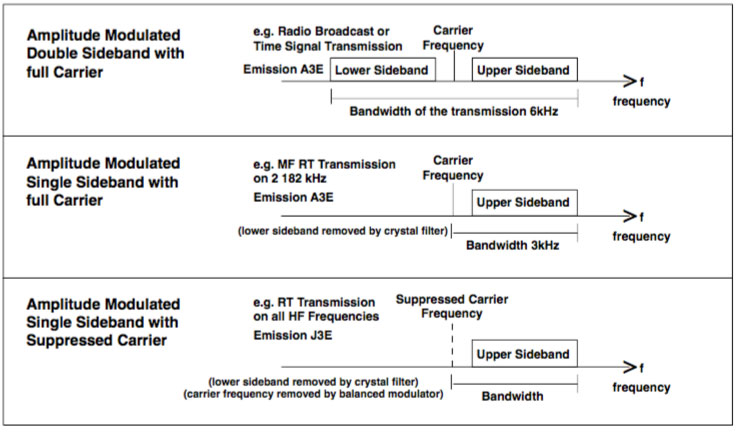
Amplitude Modulation (AM) is the method of modulation used on all MF and HF Maritime Mobile Bands. In this system the amplitude of the radio frequency carrier is modulated or varied by the audiosignal. This blazon of modulation produces a radio frequency carrier and 2 'sidebands' which comprise the audio information. It is sometimes referred to as 'Double Sideband'.
This system is used by dissemination stations, such as commercial and ABC radio stations.
Single Side ring, suppressed carrier. The two sidebands in the double sideband system described previously each contain identical sound data. Single Side Band, suppressed carrier equipment contains special filters that completely remove the radio carrier and i of the sidebands from a double sideband signal. This allows a keen increase in efficiency, as all the radio frequency ability is full-bodied in ane sideband but - either the Lower Side Band (LSB) or the Upper Side Band (USB). SSB receivers automatically re-insert the carrier, and de-modulate the sound signals in the same way as a double sideband AM (A3E) receiver.
Unmarried Side Band, suppressed carrier (J3E) operation is mandatory on all maritime MF and HF radiotelephone channels, apart from 2 182 kHz. The Upper Side Band (USB) mode of operation is used. Some equipment does provide facilities to enable selection of the Lower Side Ring (LSB) mode of performance - this must not be used.
Unmarried Side band full carrier. Under the ITU Radio Regulations this manner is only permitted on the MF International Distress frequency of two 182 kHz. This mode is known as "compatible AM" or H3E.
Because of its full carrier, Double Side Band receivers are able to receive these signals. Although the H3E emission manner has been phased out, some ships and coast stations continue to use SSB full carrier (H3E) on 2 182 kHz. However radiotelephone communications, including distress traffic, on 2 182 kHz should be conducted on SSB suppressed carrier emission (J3E). (Further information is available in ITU 2012 Radio Regulations Appendix 15.)
The various forms of aamplitude modulation are shown in Effigy.
Frequency Modulation (FM) - in this arrangement the frequency of the radio frequency carrier is modulated or varied by the audio betoken. As FM produces high quality sound, given su cient bandwidth, it is used in tv and radio broadcasting (east.g. FM stereo).
FM is not used on marine MF or HF frequencies. A close variant of FM, called Phase Modulation (PM), is used exclusively on the VHF marine band.
Digital Selective Calling (DSC)
DSC is a paging technique used to automate the initial telephone call between two stations. The technical principles are well-nigh identical to NBDP, in that tone information is transmitted from one DSC system to another over a radio link.
DSC is used in the MF, HF and VHF marine bands for distress, urgency and safe alerting.
VHF DSC systems operate at far greater speed than MF or HF systems - 1 200 bits of information per second on VHF, 100 bits of data per second on MF/HF.
Bandwidth of emissions
The bandwidth of a signal is the amount of Radio Frequency spectrum occupied past that signal. Unlike modulation methods produce unlike bandwidths. Typical bandwidths for the various forms of modulation in maritime are:
FM – upwards to 10 kHz (however signals of up to 16 kHz may exist accommodated)
AM – 3 kHz
SSB – up to 3 kHz
NBDP and DSC – 170 Hz
Classification and designation of emissions
Appendix 1 of the ITU Radio Regulations establishes a system of identifying radio emissions by designating the bandwidth and classifying the characteristics of the emission. As such an emission can be identi ed in terms of:
- The bandwidth allocated;
- The characteristics of the modulation and the modulating signal; and
- Any boosted characteristics.
A total of ix letters and figures tin be used to classify a radio emission, the beginning four indicating the bandwidth, and the next three the modulation characteristics. The final 2 characters are optional and may be used to identify the details of the betoken and the nature of multiplexing where appropriate. The first two groups of characters are of greatest relevance to the GMDSS, an case of how these groups are employed is demonstrated below:From the emission classified every bit:
2K80J3E
The kickoff four characters (2K80) designate a bandwidth of 2.viii kHz.
Nomenclature
The side by side three characters give the:
- Blazon of Modulation of the main carrier;
- Nature of indicate modulating the main carrier; and
- The type of information to be transmitted.
For the example J3E this corresponds to:
J = single sideband, suppressed carrier
3 = single channel containing analogue information
E = telephony
The following simplified designators are commonly used in the GMDSS:
J3E = Single sideband (SSB)
F3E = Frequency modulation (FM)
G3E = Phase modulation used on VHF
F1B or J2B = Narrow Band Direct Press (NBDP) or Digital Selective Calling (DSC)
F3C = Facsimile (Fax)
A complete list of emission designators may be institute in the Manual for apply past the Maritime Mobile and Maritime Mobile - Satellite Services (detailed in Appendix 1, Department 2). This publication is carried by all GMDSS vessels.
Comments

What Frequencies Are Assigned To The Commercial Land Service,
Source: https://gmdsstesters.com/radio-survey/general/general-principles-and-features-of-maritime-mobile-service.html
Posted by: boydflid1954.blogspot.com
0 Response to "What Frequencies Are Assigned To The Commercial Land Service"
Post a Comment