

What Are Examples Of Services That Are Contracted Out
What is outsourcing?
Outsourcing is when companies, charities or other organisations run services on behalf of the government. These contracts are ordinarily awarded following a competitive tendering procedure.
Examples of outsourced services include collecting household waste; cleaning schools, hospitals and government offices; providing IT services and support; managing prisons; and providing residential care to the elderly. Over £100 billion a twelvemonth is spent on outsourcing by central and local government, and public bodies.[1]
The rationale for outsourcing is that applying market mechanisms and private sector expertise to the work of government tin reduce costs, raise quality and achieve wider benefits such as greater innovation and improved efficiency.
What is privatisation?
Privatisation is the sale of publicly owned avails to individual investors. Investors take on responsibility for operating, managing and investing in the assets – and providing any services that derive from them in render for a fee from users. In the U.k., the most well-known examples of privatisation have been utilities, such as energy, h2o and telecoms, and other avails such every bit rail and post.
Early proponents of privatisation believed that creating markets would ensure services were efficiently produced and high quality, and the need for regulation would "wither away" every bit competition took concord. In practice this has non happened. These industries remain highly regulated – in several, regulators prepare the prices companies tin can charge and the amount they are expected to invest.[ii]
Opponents of the involvement of private companies in the health service ofttimes complain about "NHS privatisation". This is the wrong term. NHS bodies contract private companies to deliver wellness services, often to help meet high need, but NHS avails are not "sold off".
Does this terminology really affair?
Yes. While they are often used interchangeably, outsourcing and privatisation are not the same thing. They have some similarities but besides some large differences. The reasons why they have or have not worked are not necessarily the same.
Our enquiry establish that outsourcing has helped to drive improvements in efficiency and innovation in some areas, but at that place have been failures when authorities has not done enough due diligence on suppliers, been as well focussed on price or allocated risks poorly.
Some dynamics are similar for privatisation. As with outsourcing, regime has struggled to get companies to focus on broader goals rather than maximising profits. And as with outsourcing, asymmetric data (when the visitor has data authorities does not) has left service design and commitment vulnerable to 'gaming' – for instance private companies misrepresenting the quality of performance.
Only dissimilar with outsourcing, failures to overcome these issues in privatised assets centre on the role of regulation. Authorities has ofttimes proved unwilling or unable to equip regulators with enough teeth to become companies to conduct in certain ways. Despite regulators mandating low turn a profit margins, for example, investors take managed to load companies with debt and excerpt big profits, particularly in the h2o sector. Some other departure is effectually fees: there has also long been argue over how to balance keeping costs depression for passengers and consumers against the need for long-term investment.
In several areas, variants and hybrid models have emerged. In rail, the rails and the rolling stock were initially sold off to separate companies, just Network Rail, which manages the track, was after brought back nether government control every bit an arms-length body of the Department for Ship (DfT). Train operators, which charter trains from rolling stock companies, are given contracts – or franchises – to operate routes over a specified period.[3]
Under Private Finance Initiative (PFI) contracts, outsourcers have congenital assets, such as prisons, and then operated them for an agreed contract menstruum, typically 25–30 years. In nigh cases, these assets will return to public ownership when the contracts expire.[4]
Why are outsourcing and privatisation relevant at present?
At the 2019 general election, Labour said it would return privatised utilities to public hands and "end all privatisation" (they meant outsourcing) in the NHS. In the 2020 leadership election, Sir Keir Starmer backed these policies – and, then far, every bit leader he remains committed to them.
Recent Conservative governments have likewise acknowledged that outsourcing and privatisation take not always worked every bit intended. For instance, the May government looked at government outsourcing in the wake of Carillion's plummet and commissioned the Williams review of the structure of the runway industry.
Reassessments accept connected under the Johnson administration, and some of the difficulties have become more than acute due to the coronavirus pandemic. In June 2020, Robert Buckland, the justice secretarial assistant, decided to bring probation in England and Wales fully back in-firm from June 2021, citing the demand for greater "flexibility, control and resilience" to manage the impacts of the virus.
DfT has introduced a new franchising system for Britain's rail providers: operators are paid a management fee, but government bears all cost and revenue risk. This is a curt-term measure, but it appears probable to exist like to the arrangement the Williams review, notwithstanding notwithstanding to report, will recommend and may bear witness to be the government's preferred longer-term pick.[5]
Debate near whether to return outsourced services and privatised utilities to public hands looks set to rumble on.
What if government does choose to take back control of services or assets?
An increasing number of local government and public bodies have already decided to bring outsourced services back in-house. For example, Hackney Quango took over its waste collection in 2010 later on two decades of contracting out, while the DVLA began running its own It in 2014.
This is known as 'insourcing'. Equally we set out in a recent written report, insourcing can bring benefits including better quality and greater flexibility – but those choosing to exercise it need to ensure they empathise the service, honestly assess whether they have the capability to evangelize it better, and plan the transition advisedly. There are several options between fully in-house and fully outsourced provision, such as joint ventures and trading companies (see chart). Each has pros and cons.
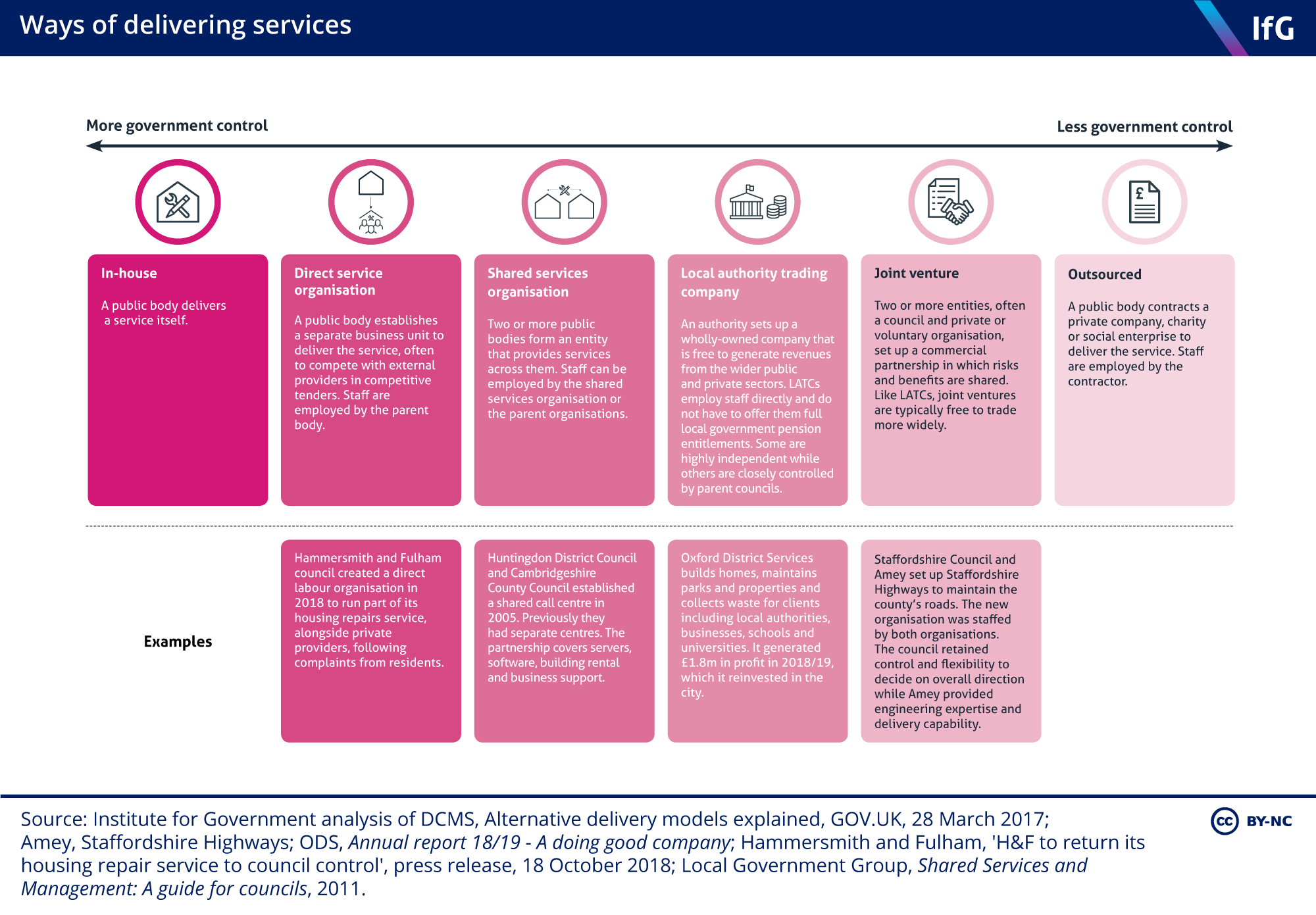
Renationalising privatised assets is an birthday different prospect. While there is footling conclusive evidence that privatisation has improved quality or efficiency – some studies bear witness improvements, others do not[6] – in that location is a debate to be had over whether renationalisation is now the best approach (we had that contend at the IfG during the 2019 election, bachelor to sentry on YouTube).
Broadly, advocates of renationalisation argue that changing ownership models is the best way to address problems such as poor quality, underinvestment and excessive executive pay. Critics contend that when utilities were previously nationalised it was not a neat success and – in areas such every bit energy and h2o – better regulation would be a more than effective solution.
A government that wanted to take dorsum control of the operation of railways could simply wait for current franchises to cease, but full renationalisation would mean buying back the rolling stock. In energy, water, mail and telecoms, authorities would also need to buy out the companies that own the underlying assets.
There is disagreement about how to price avails and companies fairly. Various methods have been floated, including market value plus or minus a certain amount or what is known is the Regulated Asset Base (RAB), which is based on what investors originally paid plus subsequent majuscule expenditure. At the 2019 ballot most discussion focussed on RAB, but in that location was discord over what premium should be paid on acme of it for the risks investors have taken. [7] Whatsoever price would demand to be seen as reasonable to avoid dissentious investment in the wider economic system.
[ii] Johnson P, 'It'due south not obvious from the past that government can better run utilities', Found for Fiscal Studies, blog, 2 Oct 2017, www.ifs.org.britain/publications/9962
[5] The Economist, 'A bailout for Britain'southward railways', 21 March 2020, retrieved 22 March 2020, www.economist.com/ britain/2020/03/21/a-bailout-for-britains-railways;
[vii] The Labour political party said it would use RAB and others agreed using marketplace value could be problematic with large fluctuations in share cost. The CBI has used RAB plus thirty% to estimate that Labour's renationalisation plans would toll £196bn. But Dieter Helm, an skillful on regulated utilities, argued this was "absurd" and around RAB plus 10% would be considered fair. BBC News, 'Labour's nationalisation price tag would beginning at £196bn, CBI says', BBC News, 16 October 2019, www.bbc.co.uk/news/business organisation-50036463; BBC Radio 4, 'Nationalisation – how would information technology piece of work?' The Conference Room, 27 September 2018, www.bbc.co.uk/sounds/play/b0bkv1vd

What Are Examples Of Services That Are Contracted Out,
Source: https://www.instituteforgovernment.org.uk/explainers/outsourcing-and-privatisation
Posted by: boydflid1954.blogspot.com
0 Response to "What Are Examples Of Services That Are Contracted Out"
Post a Comment