

Which Phone Service Rings In The Lirr Tunnels
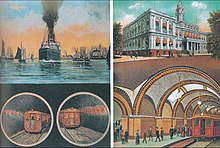 1913 postcard illustrating the tunnel and Urban center Hall station | |
| Overview | |
|---|---|
| Line | IRT Lexington Avenue Line (4 and v trains) |
| Location | East River betwixt Manhattan and Brooklyn, New York |
| Coordinates | 40°41′49″N 74°00′26″Westward / 40.69694°N 74.00722°Westward / 40.69694; -74.00722 Coordinates: twoscore°41′49″Due north 74°00′26″Due west / forty.69694°N 74.00722°W / xl.69694; -74.00722 |
| System | New York City Subway |
| Operation | |
| Opened | January 9, 1908 (January nine, 1908) [1] |
| Operator | Metropolitan Transportation Authority |
| Technical | |
| Length | half dozen,550 feet (ii,000 one thousand) |
| No. of tracks | 2 |
| Width | xvi.67 feet (5.1 grand) (exterior) fifteen.5 feet (4.seven k) (interior) |
| Joralemon Street Tunnel | |
| U.S. National Register of Historic Places | |
| Architect | William Barclay Parsons; Andrew McDonald, et al. |
| MPS | New York Metropolis Subway System MPS |
| NRHP referenceNo. | 06000015[two] |
| Added to NRHP | Feb nine, 2006 |
The Joralemon Street Tunnel, originally the Brooklyn–Battery Tunnel, is a pair of tubes carrying the IRT Lexington Artery Line (4 and 5 trains) of the New York Urban center Subway under the East River between Bowling Green Park in Manhattan and Brooklyn Heights in Brooklyn, New York City. The Joralemon Street Tunnel was an extension of the Interborough Rapid Transit Company (IRT)'s first subway line from the Bowling Green station in Manhattan to the IRT Eastern Parkway Line in Brooklyn.
The tubes were constructed using the shield method and are each 6,550 feet (2,000 m) long and 15.5 feet (4.vii chiliad) wide. The interiors are lined with cast-iron "rings" formed with physical. The tubes descend 91 to 95 feet (28 to 29 m) beneath the mean high water level of the East River, with a maximum gradient of iii.1 percentage. During the tunnel'southward construction, a house at 58 Joralemon Street in Brooklyn was converted into a ventilation building and emergency exit.
The Joralemon Street Tunnel was the first underwater subway tunnel connecting Manhattan and Brooklyn. It was built by the IRT equally part of Contract 2, which the IRT signed with the Rapid Transit Commission in 1902. Construction commenced in 1903 and the tubes were completed by 1907, despite diverse construction accidents and technology errors that required part of the tunnel to be rebuilt. The kickoff train ran through the Joralemon Street Tunnel in November 1907, and the tunnel opened for passenger service on January nine, 1908. Information technology was listed on the National Register of Historic Places in 2006.
Clarification [edit]
The Joralemon Street Tunnel, consisting of ii parallel tubes, crosses the Eastward River, connecting the New York Metropolis boroughs of Manhattan in the west and Brooklyn in the east. Completed in 1908 for the Interborough Rapid Transit Company (IRT), it was the first subway tunnel between the two boroughs,[3] and was built as part of Contract two of the first New York City Subway line.[4] [5] The tubes extend betwixt South Ferry in Lower Manhattan and Joralemon Street in Brooklyn Heights, Brooklyn,[five] with the road of the tunnel curving at either banking company of the river.[half-dozen] The chief engineer for the tunnel was William Barclay Parsons, who designed most of the early IRT system,[3] while Clifford Milburn The netherlands served as the assistant engineer.[7] The New York Tunnel Company was the principal contractor.[eight] When completed, it was known equally the Brooklyn–Battery Tunnel, a name subsequently used for a vehicular tunnel slightly to the southward.[9]
Each tube is approximately vi,550 feet (2,000 m) long,[v] [half dozen] [10] [a] with the sections under the river being iv,500 anxiety (one,400 m) long.[3] The tunnels have an outside diameter of 16.67 feet (5.one m)[12] and an inside diameter of 15.v feet (4.7 m).[5] [12] [13] The centers of the tubes were placed about 28 feet (8.v thou) autonomously, except under Joralemon Street, where that distance is 26 anxiety (seven.9 m).[14] Both tubes accept a maximum gradient of 3.one percent.[5] [13] [15] The lowest points on the tubes are about 91 to 95 feet (28 to 29 m) beneath the mean high water level of the Due east River.[thirteen] [xv] [16] [b] About 700 feet (210 m) of the tunnel in Brooklyn is higher up the water level of the river.[sixteen] While the Manhattan finish of the tunnels was constructed through solid rock, the Brooklyn end was synthetic through sandy footing.[eighteen] [nineteen]
The steelwork for Contract 2 tunnels, including the Joralemon Street Tubes, was manufactured by the American Bridge Visitor.[20] The tubes are lined with "rings" 22 inches (560 mm) wide, each of which is made of "plates" that form a perfect circle.[half dozen] [12] [17] [c] Each ring has a minimum thickness of i.125 inches (28.6 mm) and has flanges that are seven to 7.5 inches (180 to 190 mm) deep.[6] [13] [14] The rings inside the rocky sections, and inside the segments of the tunnel above mean loftier water, generally weigh less than those placed within sandy ground or underneath the riverbed.[thirteen] After the rings were placed, they were covered with concrete, and bench walls with cablevision ducts were placed bated each tube. Piping and drainage systems were also installed.[14] [xv] Pilings were sunk for additional reinforcement.[13]
Associated structures [edit]
The Manhattan end of the tunnel is the Bowling Green station of the IRT Lexington Avenue Line. North of Bowling Green, the subway runs under Broadway to connect to the original subway line. The Brooklyn stop is at Joralemon and Clinton Streets in Brooklyn, where a cut-and-embrace tunnel connects to the Borough Hall station of the IRT Eastern Parkway Line.[8] [xiii] [16]

South Ferry ventilation shaft
Two construction shafts were built for the tunnel: one in Manhattan at South Ferry, and the other in Brooklyn at Henry and Joralemon Streets. Each shaft was built with dimensions of about 14 by 45 feet (4.3 past 13.7 m).[half dozen] [13] The Southward Ferry structure shaft became a ventilation shaft and consists of a ten-foot-high (three.0 m) enclosure inside the Bombardment.[xiv] However, the Henry Street construction shaft was infilled.[eight] [fourteen] A ventilation and emergency exit shaft was built inside a row house at 58 Joralemon Street, nigh Willow Street.[21] [22] [23] 58 Joralemon Street was an actual house, built in 1847,[21] but was purchased by the IRT in 1907 and gutted.[24]
History [edit]
Planning [edit]
Planning for the city'south first subway line dates to the Rapid Transit Human activity, authorized by the New York State Legislature in 1894.[25] The subway plans were fatigued up by a team of engineers led by William Barclay Parsons, chief engineer of the Rapid Transit Commission (RTC). Information technology called for a subway line from New York Urban center Hall in lower Manhattan to the Upper West Side, where two branches would atomic number 82 north into the Bronx.[26] A plan was formally adopted in 1897.[27] The Rapid Transit Subway Construction Visitor (RTSCC), organized by John B. McDonald and funded by Baronial Belmont Jr., signed Contract ane with the RTC in February 1900,[28] in which it would construct the subway and maintain a fifty-yr operating charter from the opening of the line. Belmont incorporated the IRT in Apr 1902 to operate the subway.[29]
A subway under the southernmost department of Broadway between the Bombardment and City Hall was non included in Contract ane. Several days afterward Contract 1 was signed, the Board of Rapid Transit Railroad Commissioners instructed Parsons to evaluate the feasibility of extending the subway southward to Due south Ferry and then to Brooklyn. On January 24, 1901, the Board adopted a road that would extend the subway from Metropolis Hall to the Long Isle Rail Route (LIRR)'due south Flatbush Artery final station (now known as Atlantic Terminal) in Brooklyn, via a tunnel under the East River, and then running under Joralemon Street, Fulton Street, and Flatbush Avenue in Brooklyn to Atlantic Concluding.[30] [31] [32] It was estimated that this 2d route would cost $9 million (equivalent to $230 million in 2020[d]), which the RTC could not notwithstanding fully fund. Nonetheless, the RTC expected that there would be competition for the road, which continued two large business districts and the metropolis's 2 nigh populous boroughs. The Brooklyn Rapid Transit Company, which monopolized surface and elevated transit in Brooklyn, would exist obliged to bid to maintain its monopoly. The Board also knew that Belmont would submit a depression bid to retain control of cloak-and-dagger rapid transit for himself and his structure company.[33] Contract two, giving a charter of 35 years, was executed betwixt the commission and the Rapid Transit Construction Company on September 11, 1902.[34]
Construction [edit]
Structure on the Manhattan side began on March 4, 1903, and on the Brooklyn side on July 10, 1903.[xi] While the RTC had allocated $2 meg to the tubes' construction (equivalent to $47 meg in 2020[d]), the project was estimated to cost $10 million (equivalent to $237 million in 2020[d]) by Nov 1903.[35] Structure shafts were dug at Due south Ferry and Joralemon Street.[17] [18] Vi tunneling shields were driven: ii proceeding east from Manhattan and 2 each proceeding west and e from Brooklyn.[13] The tunneling shields were each sixteen.95 feet (v m) in bore and ix.5 anxiety (2.9 m) long, and were pushed at a charge per unit of 5 to 12 feet (1.5 to 3.7 m) per solar day.[36] All of the headings were driven within a pressurized environment. Later on the headings had been driven approximately 100 feet (30 m), two thick brick walls were constructed at each terminate, creating air locks. An upper lock gave workers access to the heading, while a lower lock allowed spoils to exist extracted from the excavation and through the shafts on either side.[6] [18] The work was performed by three groups of men, each working eight-hour shifts.[13] [17]
Afterward the shields were driven, temporary wooden beams were placed to reinforce the excavations until the cast-iron tubes were assembled.[eighteen] The bandage iron lining was assembled via a hydraulically powered, traveling device with a "radial arm"; the device was supported on brackets that ran along the completed section of the lining. In one case it had been positioned, the radial arm would lift and orient a plate into position. Three workers would bolt the plates to the already assembled lining, while a 4th would operate the device. Afterward, a compressed-air grouting machine would squeeze grout into pocket-size holes within the lining, filling the spaces between the rock and the cast-fe rings. The holes in the lining were then plugged.[12] [18] [37] Some of the cast-iron plates were cracked while they were placed, merely Parsons maintained that the tubes were rubber.[13] [38]

This house at 58 Joralemon Street was purchased and converted into a ventilation shaft for the Joralemon Street Tunnel.
The excavations acquired shifting of sandy soil, which damaged some buildings in Brooklyn along the tunnel's road, including the house of the Brooklyn borough president.[39] In June 1904, the RTC said the metropolis was not responsible for repairs to the houses, although contractors were digging another shaft to relieve air force per unit area in the digging.[twoscore] [41] The shafts at Garden Identify and at Henry Street were sealed, and new shafts at Furman Street on the waterfront were being constructed, by the end of 1904.[8] The property impairment led the New York Metropolis government to pay out monetary compensation starting in mid-1906.[42] Numerous other accidents occurred during the course of structure. In March 1905, one of the tubes of a sudden lost pressure in a "blowout", propelling a worker through the mud and into the air, although he survived.[43] That December, a blast caused the tunnel to cave-in at the Battery, though no one died.[44] A cavern-in occurred in one of the tubes in August 1906,[45] and two months after, another blast killed ane worker.[46] Another outcome was the need to create a new ventilation shaft on the Brooklyn side after the construction shaft was sealed; the IRT unsuccessfully attempted to take belongings on Hicks and Furman Streets. By 1907, the IRT had bought a house at 58 Joralemon Street to serve as the ventilation plant.[24]
Continuing with the excavations, the contractors constitute the remains of a ship under Joralemon Street in March 1905.[47] Past that August, the excavations had reached the midpoint of the riverbed.[48] During this fourth dimension, Parsons and his successor George South. Rice discovered that the ceilings of the tubes had flattened downward; trains could still run through the tunnels, but the roofs would be scraped at high speeds. Less urgently, the tunnels in Brooklyn had descended beneath the specified gradient, which if uncorrected would result in an uneven course. These difficulties had come up to the attention of mayor George B. McClellan Jr. by mid-1906.[49] [50] To prevent further delays, contractor New York Tunnel Company chose to proceed, with plans to rebuild the defective tunnel sections later.[51] Parsons blamed the contractor for the lacking tube ceilings, stating that the New York Tunnel Company had immune the quicksand higher up the tubes to settle, although the contractor denied responsibility.[52]
The two sections of the northern tube were holed-through on Dec fifteen, 1906,[53] followed by the southern tube on March 1, 1907.[54] Starting in mid-1907, some i,957 feet (596 thou) of the north tube and 962 feet (293 m) of the due south tube were reconstructed, with the lower half of each bandage-fe band beingness replaced with an elliptical section.[xiii] [e] The New York Tunnel Company became insolvent that May, and a receiver was appointed to oversee the completion of the tunnel.[56] By that July, the city's Public Service Commission ordered that boosted shifts of workers be hired for the Joralemon projection and so that exam trains could starting time running through the tunnels inside three months.[57] The kickoff exam train, carrying officials, reporters, and construction engineers, ran through the Joralemon Street Tunnel to Brooklyn at 12:40 p.m. on November 27, 1907.[15] [58]
Functioning [edit]

The commencement of the tunnel just s of the Bowling Green station
The Joralemon Street Tunnel and the Borough Hall station opened to the public on January 9, 1908, with ceremonies, firecrackers, and a musical functioning on the steps of Brooklyn Borough Hall.[1] [thirteen] [59] Initially, the tunnel was served by limited trains along both the West Side (now the Broadway–Seventh Avenue Line to Van Cortlandt Park–242nd Street) and East Side (at present the Lenox Avenue Line). The express trains, running to Atlantic Artery, had their northern terminus at 242nd Street or West Farms (180th Street).[60] Lenox local trains to 145th Street served the tunnel during late nights.[61] In Brooklyn, service proceeded beneath Joralemon, Fulton, and Willoughby Streets, originally terminating at Atlantic Avenue.[5] The opening of the Joralemon Street Tunnel, as well as the completion of the Williamsburg Bridge and Manhattan Bridge to the north, relieved traffic from the Brooklyn Span and from Due east River ferries, which previously had provided the just rider service between Manhattan and Brooklyn.[62]
The Dual Contracts were formalized in early 1913, specifying new lines or expansions to be built by the IRT and the BRT.[63] As role of the Dual Contracts, the IRT extended the Lexington Artery Line north of K Central–42nd Street, dividing the original IRT line into an "H"-shaped arrangement. The "H" system opened in 1918, and all Joralemon Street Tunnel services were sent via the Lexington Avenue Line.[64] The following yr, the Clark Street Tunnel opened north of the Joralemon Street Tunnel, providing service from the newly extended Broadway–7th Avenue Line to the IRT's Brooklyn line.[65] Another tunnel, the Montague Street Tunnel, was built north of the Joralemon Street Tunnel as part of the Dual Contracts, opening in 1920 as part of the BRT arrangement.[66] Also in 1920, the Eastern Parkway Line was extended east of Atlantic Avenue; the Joralemon Street Tunnel services, which had previously served all stops on the Eastern Parkway Line, became limited services.[67] [68]
In the latter half of the 20th century, several derailments occurred in the Joralemon Street Tunnel. A Brooklyn-bound train batty during the morning rush hr of January one, 1965, blocking service for half a day, although no ane was harmed.[69] During the evening rush hr of March 17, 1984, some other train derailed with one,500 passengers while traveling over a runway that was beingness repaired, only again, no ane was killed or seriously injured.[70] [71]
The Joralemon Street Tunnel was added to the National Register of Celebrated Places in 2006.[72] It was ane of seven E River subway tunnels flooded on October 29, 2012, as Hurricane Sandy's storm surge inundated Lower Manhattan. The Metropolitan Transportation Authority prioritized draining and restoring service to the Joralemon Street Tunnel and Rutgers Street Tunnel, which carried some of the arrangement'due south busiest routes.[73] [74] The storm water was cleared from the tunnel two days afterward,[75] and the tunnel reopened within the week.[74] The tunnels were more extensively repaired during 2016 and 2017 for $75 million.[76] [77]
References [edit]
Notes [edit]
- ^ According to the Brooklyn Daily Hawkeye, the north tube used 6,747 feet (ii,056 grand) of cast iron, while the south tube used 6,766 anxiety (2,062 m) of such material.[xi]
- ^ Sources disagree on how thick the river bed to a higher place the tubes is. According to a 1904 article in the Technology Record, the river bed above each tube is 6 to 30 feet (1.8 to ix.ane m) thick,[6] but a 1903 account from The New York Times gives a minimum thickness of 25 to 30 anxiety (vii.half dozen to 9.ane m).[17] A Brooklyn Daily Eagle article in 1907 stated that the maximum depth of the tube was 40 feet (12 g) beneath the river bed.[fifteen]
- ^ According to the National Park Service, there are eight plates in each ring.[ten] According to The New York Times and the Engineering Tape, in that location are nine plates, only the topmost plate of each band is smaller than the residual and is similar in function to the keystone of an arch.[17] [16]
- ^ a b c Johnston, Louis; Williamson, Samuel H. (2022). "What Was the U.S. Gdp And so?". MeasuringWorth . Retrieved Feb 12, 2022. Usa Gross Domestic Product deflator figures follow the Measuring Worth series.
- ^ A total of two,919 feet (890 m) was reconstructed;[xiii] the National Park Service cites this figure equally the length of the northward tube that was reconstructed.[55]
Citations [edit]
- ^ a b "Brooklyn Joyful Over Its Tunnel". The New York Times. Jan ten, 1908. ISSN 0362-4331. Retrieved March 6, 2010.
{{cite news}}: CS1 maint: url-status (link) - ^ "National Register Information System". National Register of Historic Places. National Park Service. January 23, 2007.
- ^ a b c National Park Service 2006, p. 7.
- ^ Gasparini, D. A. (February 2006). "Battery-Joralemon Street Tunnel". Periodical of Performance of Constructed Facilities. American Society of Civil Engineers. xx (1): 92–107. doi:ten.1061/(asce)0887-3828(2006)20:1(92). Archived from the original on May 30, 2012. Retrieved October 12, 2007.
- ^ a b c d due east f Scott 1978, p. 261.
- ^ a b c d e f yard "The New York and Brooklyn Tunnel for the Rapid Transit Railroad-I". Engineering science Tape. 49 (10): 304–306. March 5, 1904.
- ^ Aronson, Michael (June 15, 1999). "The Digger Clifford Kingdom of the netherlands". New York Daily News . Retrieved July 2, 2010.
- ^ a b c d "One Tunnel Tube Finished to River". Brooklyn Citizen. December 3, 1904. p. 1. Retrieved January five, 2021 – via newspapers.com
 .
. - ^ New York City Transit: A Memorandum Addressed to the Public Service Committee of the Starting time District. City Club of New York. 1907. Retrieved November five, 2012.
- ^ a b National Park Service 2006, p. 3.
- ^ a b "Statistics of East River Tunnel". Brooklyn Daily Eagle. Jan 9, 1908. p. 26. Retrieved January v, 2021 – via newspapers.com .
- ^ a b c d National Park Service 2006, pp. 3–4.
- ^ a b c d e f g h i j 1000 l chiliad north "Construction of the Tunnel Presented Difficult Bug". Brooklyn Daily Eagle. Jan 9, 1908. pp. 26, 27.
- ^ a b c d e National Park Service 2006, p. four.
- ^ a b c d e "First Train Run Through Tunnel". Brooklyn Daily Eagle. November 27, 1907. p. 1. Retrieved January 5, 2021 – via newspapers.com .
- ^ a b c d "Tunneling Nether the East River, New York". Engineering Record. 43 (6): 128. February 9, 1901.
- ^ a b c d east "Tunnel Piece of work in Brooklyn With Street Undisturbed; Skilful Progress Made Nether Joralemon Street Toward Borough Hall During the By Month" (PDF). The New York Times. October 11, 1903. p. 26. ISSN 0362-4331. Retrieved January four, 2021.
- ^ a b c d e Scott 1978, p. 262.
- ^ "Tunnel Shaft in Manhattan Now Down to River Level". Brooklyn Standard Union. May 10, 1903. p. 10. Retrieved January 5, 2021 – via newspapers.com .
- ^ "Modern Engineer's Magic Wand Transforms Atlantic Avenue". Brooklyn Citizen. July 14, 1904. pp. 13, nineteen – via newspapers.com .
- ^ a b Gill, John Freeman (December 26, 2004). "A Puzzle Tucked Amid the Brownstones". The New York Times. ISSN 0362-4331. Retrieved Jan 4, 2021.
- ^ Hays, Tom; Sherman, Samantha (April 12, 2010). "Subterranean Police Presence Protects Subways From Terror". The Brooklyn Daily Hawkeye. Archived from the original on July one, 2010.
- ^ National Park Service 2006, pp. 4–5.
- ^ a b "Fresh Air for Tunnel: Constitute Site Purchased". New-York Tribune. March 23, 1907. p. 4. Retrieved January 5, 2021 – via newspapers.com .
- ^ Walker 1918, pp. 139–140.
- ^ "Interborough Rapid Transit System, Clandestine Interior" (PDF). New York City Landmarks Preservation Commission. Oct 23, 1979. p. 3. Retrieved November 19, 2019.
- ^ Walker 1918, p. 148.
- ^ Report of the Board of Rapid Transit Railroad Commissioners for the City of New York For The Yr Catastrophe December 31, 1904 Accompanied By Reports of the Primary Engineer and of the Auditor. Board of Rapid Transit Railroad Commissioners. 1905. pp. 229–236.
- ^ Walker 1918, p. 182.
- ^ Walker 1918, p. 221.
- ^ Written report of the Board of Rapid Transit Railroad Commissioners For And In The Urban center of New York Up to December 31, 1901. Board of Rapid Transit Railroad Commissioners. 1902. pp. 83–84.
- ^ Scott 1978, pp. 260–261.
- ^ Katz, Wallace B. (1979). "The New York Rapid Transit Determination of 1900: Economy, Guild, Politics" (PDF). Historic American Engineering science Tape. p. 111 (PDF p. 112).
 This commodity incorporates text from this source, which is in the public domain .
 {{cite spider web}}: CS1 maint: postscript (link) - ^ Walker 1918, p. 179.
- ^ "East River Loss Estimated at $8,000,000". Brooklyn Daily Hawkeye. Nov 25, 1903. p. ii. Retrieved January five, 2021 – via newspapers.com .
- ^ "Trains Nether East River Before End of Next Year". Brooklyn Daily Eagle. March 27, 1904. p. 11. Retrieved January v, 2021 – via newspapers.com .
- ^ "The New York and Brooklyn Tunnel for the Rapid Transit Railroad-II". Engineering Record. 49 (eleven): 329–331. March 12, 1904.
- ^ "Brooklyn Non Sure Tunnel Is Safety; Mayor Is Asked to Gild an Investigation of Work on the East River Tubes" (PDF). The New York Times. June 3, 1907. p. one. ISSN 0362-4331. Retrieved January 5, 2021.
- ^ "Fine Mansion Sinking Into Brooklyn Tunnel". Brooklyn Daily Eagle. March 4, 1904. p. 20. Retrieved January 5, 2021 – via newspapers.com .
- ^ "Property Owners Must Make Their Own Repairs". Brooklyn Daily Hawkeye. June 17, 1904. p. 5. Retrieved January 5, 2021 – via newspapers.com .
- ^ "Run into a Snag in Joralemon St. Tunnel". Brooklyn Standard Union. June 17, 1904. p. 12. Retrieved January five, 2021 – via newspapers.com .
- ^ "Jacobs Tunnel Report Refused to Mr. Rice". Brooklyn Daily Eagle. June 7, 1906. p. 2. Retrieved January 5, 2021 – via newspapers.com .
- ^ "Shot Out of River". New York Sun. March 28, 1905. p. 1. Retrieved January 5, 2021 – via newspapers.com .
- ^ "Eastward River Tunnel Caves at the Bombardment; Elevated Railroad Structure and Subway Are Menaced" (PDF). The New York Times. December 24, 1905. p. 1. ISSN 0362-4331. Retrieved January 4, 2021.
- ^ "E River Breaks in on Ix Tube Workers; a Blitz for Rubber Follows the "Accident-out" of Quicksand" (PDF). The New York Times. August xvi, 1906. p. 14. ISSN 0362-4331. Retrieved Jan v, 2021.
- ^ "Dead in Due east River Tunnel; Workman Killed and Three Injured by a Blast of Dynamite" (PDF). The New York Times. October i, 1906. p. 1. ISSN 0362-4331. Retrieved Jan 4, 2021.
- ^ "Find Erstwhile Ship Under Street". Brooklyn Citizen. March 11, 1905. p. 1. Retrieved January 5, 2021 – via newspapers.com .
- ^ "Under-river Subway More Than One-half Done; Diggers From the Battery at the Middle of the Stream" (PDF). The New York Times. Baronial four, 1905. p. 12. ISSN 0362-4331. Retrieved January 4, 2021.
- ^ "Brooklyn Tunnel Botched, Mayor Tells R. T. Board". Brooklyn Standard Union. May 18, 1906. p. three. Retrieved January 5, 2021 – via newspapers.com .
- ^ "Tunnel Bungling Will Cost ane Year". Brooklyn Daily Hawkeye. May eighteen, 1906. pp. 1, ii.
- ^ "Brooklyn Tunnel Prepare by January 1, Sure; Engineer Rice Tells About Those Defects the Mayor Found" (PDF). The New York Times. May 25, 1906. p. 20. ISSN 0362-4331. Retrieved January 5, 2021.
- ^ "Tunnel Repairs Dispute.; Suit May Result, as Contractors Don't Desire to Pay for the Work" (PDF). The New York Times. September 9, 1907. p. xvi. ISSN 0362-4331. Retrieved January 5, 2021.
- ^ "First Trip Through New Eastward River Tube; Officials Cantankerous the Subway Tunnel to Brooklyn" (PDF). The New York Times. Dec fifteen, 1906. p. 6. ISSN 0362-4331. Retrieved January v, 2021.
- ^ "Subway Articulate to Brooklyn; Last of Tube Headings Joined by Pushing Dick Creedon Through the Earth" (PDF). The New York Times. March 2, 1907. p. 6. ISSN 0362-4331. Retrieved January 5, 2021.
- ^ National Park Service 2006, p. five.
- ^ "Tunnel Co. Insolvent: Receiver Appointed for Corporation Building Battery Tube". New-York Tribune. May 24, 1907. p. 11. Retrieved Jan 5, 2021 – via newspapers.com .
- ^ "East River Tunnel to Open up in October; Subway Trains Will Probably Run to Atlantic Avenue, Brooklyn, a Month Later". The New York Times. July 27, 1907. ISSN 0362-4331. Retrieved January 4, 2021.
- ^ "Train Goes Through the Bombardment Tunnel; Render Trip From Civic Hall to Manhattan Made in Five Minutes" (PDF). The New York Times. November 28, 1907. p. 1. ISSN 0362-4331. Retrieved Jan 5, 2021.
- ^ "Brooklyn Tunnel is Formally Opened". Brooklyn Citizen. January 9, 1908. pp. 1, two – via newspapers.com .
- ^ The Merchants' Association of New York Pocket Guide to New York. Merchants' Association of New York. March 1906. pp. 19–26.
- ^ "Tunnel to Brooklyn to Open Next Week; Subway Extension Under E River May Begin Carrying Passengers on Thursday" (PDF). The New York Times. January 4, 1908. p. one. ISSN 0362-4331. Retrieved January 5, 2021.
- ^ Hood, Clifton (1978). "The Touch on of the IRT in New York City" (PDF). Celebrated American Technology Tape. p. 153. Retrieved December 20, 2020. This article incorporates text from this source, which is in the public domain .
{{cite web}}: CS1 maint: postscript (link) - ^ "Money Set Bated for New Subways; Board of Estimate Approves City Contracts to exist Signed To-mean solar day with Interboro and B.R.T." (PDF). The New York Times. March 19, 1913. ISSN 0362-4331. Retrieved Nov x, 2017.
- ^ "Open up New Subway Lines to Traffic; Called a Triumph — Great H System Put in Functioning Marks an Era in Railroad Construction — No Hitch in the Plans — Only Public Gropes Blindly to Find the Fashion in Maze of New Stations — Thousands Go Off-target — Leaders in Metropolis's Life Hail Accomplishment of Swell Task at Coming together at the Astor" (PDF). The New York Times. Baronial 2, 1918. p. 1. Retrieved November 6, 2016.
- ^ "New Subway Service Between Brooklyn and Manhattan Boroughs" (PDF). The New York Times. Apr 13, 1919. p. 114. ISSN 0362-4331. Retrieved September 5, 2009.
- ^ "New Subway Link Opens; Service Started Through Queens and Montague Street Tubes". The New York Times. Baronial 1, 1920. Retrieved February 13, 2010.
- ^ "More than Interborough Service for Brooklyn 2 New Lines". pudl.princeton.edu. Interborough Rapid Transit Company. Baronial 23, 1920. Retrieved September nineteen, 2016.
- ^ "Brooklyn Tube Extensions Open up: I.R.T. Begins Service on Eastern Parkway and Nostrand Artery Lines" (PDF). New York Times. August 23, 1920. Retrieved December 20, 2015.
- ^ Buckley, Thomas (January nine, 1965). "Due east River Tunnel Blocked by IRT Derailment; 100-Man Crew Works Hours to Clear Tracks and Beat Rush-Hour Deadline" (PDF). The New York Times. p. 27. ISSN 0362-4331. Retrieved January iii, 2021.
- ^ Derailment of New York City Transit Authority Subway Train in the Joralemon Street Tunnel New York March 17, 1984. Usa National Transportation Safety Board. 1985. Retrieved November 5, 2012.
- ^ "1,500 Led to Prophylactic as 5 IRT Cars Derail Under the East River". The New York Times. March 18, 1984. ISSN 0362-4331. Retrieved January 3, 2021.
- ^ "Federal Register, Volume 71 Issue sixteen (Midweek, Jan 25, 2006)". govinfo. January 25, 2006. Retrieved January 5, 2021.
- ^ Donohue, Pete (November one, 2012). "Repairing the New York subway system after Hurricane Sandy may be the MTA'due south biggest task yet". New York Daily News . Retrieved January v, 2021.
- ^ a b Flegenheimer, Matt (November 9, 2012). "New York Subway Repairs Edge 'on the Edge of Magic'". The New York Times. ISSN 0362-4331. Retrieved January v, 2021.
- ^ Fermino, Jennifer (October 31, 2012). "Slog to work (if yous're lucky)". New York Post . Retrieved November five, 2012.
- ^ Guse, Clayton (Oct 15, 2020). "MTA to close No. four train tunnel between Manhattan and Brooklyn for iii weekends, starting now". New York Daily News . Retrieved January v, 2021.
- ^ "It's the 112th ceremony of the Battery Tunnel. (No, not that 1.)". Brooklyn Eagle. January 9, 2020. Retrieved Jan 5, 2021.
Sources [edit]
- "Celebrated Structures Report: Joralemon Street Tunnel" (PDF). National Register of Historic Places, National Park Service. Feb nine, 2006.
- Scott, Charles (1978). "Design and Structure of the IRT: Civil Engineering" (PDF). Historic American Technology Record. pp. 208–282 (PDF pp. 209–283). This article incorporates text from this source, which is in the public domain .
{{cite web}}: CS1 maint: postscript (link) - Walker, James Blaine (1918). Fifty Years of Rapid Transit — 1864 to 1917. Law Printing.
External links [edit]
-
 Media related to Joralemon Street Tunnel at Wikimedia Commons

Source: https://en.wikipedia.org/wiki/Joralemon_Street_Tunnel
Posted by: boydflid1954.blogspot.com
0 Response to "Which Phone Service Rings In The Lirr Tunnels"
Post a Comment