

When Do You Need A 200 Amp Service
Rik is an engineer who has held a range of marketing, technical support, and management roles. He is also a qualified teacher.
Welcome to your guide to the basics of electricity.
The four nearly basic concrete quanities in electricity are:
- Voltage (V)
- Current (I)
- Resistance (R)
- Power (P)
Each of these quantities are measured using different units:
- Voltage is measured in volts (V)
- Electric current is measured in amps (A)
- Resistance is measured in ohms (Ω)
- Power is measured in watts (Westward)
Electrical ability, or the wattage of an electrical arrangement, is e'er equal to the voltage multiplied by the electric current.
A system of water pipes is often used every bit an analogy to help people understand how these units of electricity work together. In this analogy, voltage is equivalent to water pressure level, electric current is equivalent to flow charge per unit and resistance is equivalent to pipe size.
In electrical engineering, in that location is a basic equation that explains how voltage, current and resistance relate. This equation, written below, is known as Ohm'southward law.
Ohm's Law
V = I x R
Ohm'south law states that voltage is equal to the electric current flowing in a circuit times the resistance of the excursion.
One way of agreement Ohm'due south law is to employ information technology to the imaginary plumbing arrangement we've employed as a representation of an electrical system.
Let'south say nosotros take a tank of water fastened to a hose. If nosotros increment the force per unit area in the tank, more water will come out of the hose. Thus, if nosotros increase the voltage in an electrical system, we will also increase the current.
If nosotros make the diameter of the hose smaller, resistance will increment, causing less water to come up out of the hose. Thus, if nosotros increment the resistance in an electrical system, we will decrease the current.
With this brief introduction of the workings of an electrical system, let's bound into each of the units of electricity separately and larn about them in more than detail.
Read More than From Owlcation
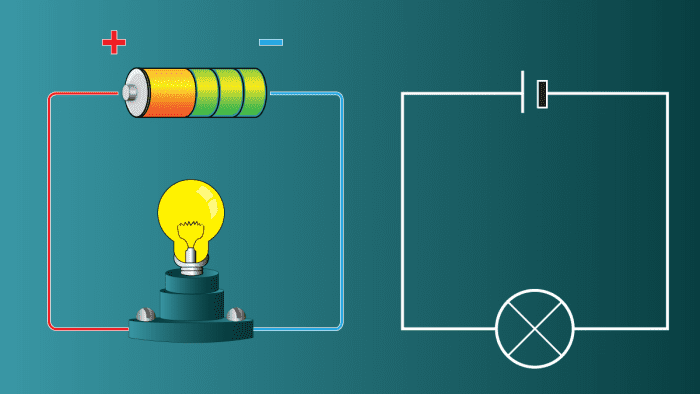
The prototype above depicts a elementary electrical circuit with a bulb, some wire, and a battery.
What Are Volts?
Volts are the base unit used to measure Voltage. I volt is divers as the "difference in electric potential betwixt two points of a conducting wire when an electric current of i ampere dissipates i watt of power between those points." The volt is named after the Italian physicist Alessandro Volta.
In our battery diagram higher up, the battery provides what is known every bit a potential difference in an electric circuit, or voltage. If we go dorsum to our h2o analogy, the bombardment is like a water pump that propels water through a pipage. The pump increases the pressure in the pipe, causing the water to flow.
In electrical engineering, we call this electrical pressure voltage and measure it in volts. A voltage of three volts can be written as 3V.
As the number of volts increases, the electric current increases too. But in order for the current to flow, the electric conductor or wire must loop back to the battery. If we pause the circuit, with a switch for example, then no electric current volition flow.
There are standard voltage outputs for everyday objects similar batteries and household outlets. In the U.s., the standard voltage output for a household outlet is 120V. In Europe, the standard voltage output for a household outlet is 230V. Other standard voltage outputs are listed in the table beneath.
Mutual Voltages
| Object | Voltage |
|---|---|
| Single-cell, rechargeable bombardment | 1.2V |
| Single-cell, not-rechargeable battery | one.5V–1.56V |
| USB | 5V |
| Automobile battery | 2.1V per cell |
| Electric vehicle battery | 400V |
| Household outlet (Japan) | 100V |
| Household outlet (North America) | 120V |
| Household outlet (Europe, Asia, Africa, Australia) | 230V |
| Rapid transit third track | 600V–750V |
| High-voltage electrical power lines | 110,000V |
| Lightning | 100,000,000V |
What Are Amps?
The ampere, often shortened to "amp" or A, is the base unit of electric current in the International System of Units. Information technology is named after the French mathematician and physicist André-Marie Ampère, who is considered the begetter of electrodynamics.
Electricity consists of the flow of electrons through a conductor, for example, an electric wire or cable. Nosotros mensurate the rate of flow of electricity as an current (just as we think of the charge per unit of menses of h2o in a river as the river electric current). The letter used to represent current in an equation is I.
Electrical current is measured in Amperes, shortened to Amps or merely the letter A.
A current of two Amps can be written every bit 2A. The bigger the current the more than electricity is flowing.
The International Arrangement of Units (SI) defines amps equally follows:
"The ampere is that constant current which, if maintained in two straight parallel conductors of space length, of negligible circular cross-department, and placed one metre apart in a vacuum, would produce between these conductors a force equal to ii×10−seven newtons per metre of length."
Electrical Current Demonstration (Video)
What Are Ohms?
Ohms are the base of operations unit of resistance in an electric system. The ohm is defined as "an electrical resistance between two points of a usher when a abiding potential difference of one volt, applied to these points, produces in the conductor a current of 1 ampere, the conductor not beingness the seat of any electromotive force." The ohm is named after the German physicist Georg Simon Ohm.
Resistance is measured in ohms, or Ω (omega), for short. So, five ohms can be written 5Ω.
In our bombardment diagram above, if we remove the bulb and reconnected the wire so the bombardment was brusque circuited, the wire and battery would get very hot and the battery would before long exist flat because there would be well-nigh no resistance in the circuit. Without whatsoever resistance, a huge electrical current would flow until the battery was empty.
Once nosotros add a bulb to the circuit, resistance is created. There is now a local "blockage" (or narrowing of the pipe, per our water pipe analogy) where the current experiences some resistance. This greatly reduces the electric current flowing in the excursion, so the energy in the battery is released more slowly.
As the battery forces the current through the bulb, the battery's energy is released in the seedling in the form of light and heat. In other words, the electric current carries stored energy from the battery to the bulb, where it is turned into light and oestrus energy.
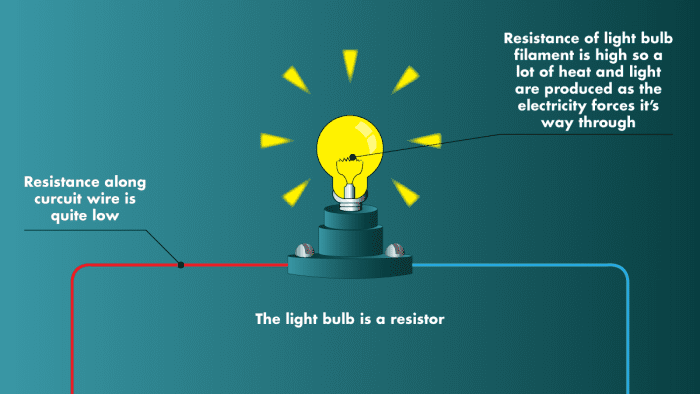
The image above shows a light bulb as the main cause of electrical resistance.
What Are Watts?
A watt is the base unit of power in electrical systems. It can also be used in mechanical systems. Information technology measures how much energy is released per second in a system. In our battery diagram, the size of both the voltage and the current in the bulb determine how much free energy is released.
In the diagram above, the low-cal bulb would get brighter equally the power, measured in watts, increases.
Nosotros can calculate the power released in the bulb, and of the electrical system as a whole, past multiplying the voltage by the current. And then, to calculate watts, the post-obit formula is used.
How to Calculate Watts
W = V * I
For case, a current of 2A flowing through a bulb with a voltage of 12V across it generates 24W of ability.
How to Calculate with Watts, Amps, Volts, and Ohms
If yous want to practise an electrical calculation involving voltage, current, resistance, or ability, reference the formulae circle below. For example, we tin calculate the ability in watts by referencing the yellow surface area in the circle.
This formulae circle is very useful for many electrical engineering tasks. Go on it handy the next time you are dealing with an electrical system.
Below are some example equations that are solved using the formulae.
Example Equations
1. What is the current in an electrical circuit with a voltage of 120V and 12Ω of resistance?
I = V/R
I = 120/12
I = 10A
The electric current in an electrical circuit with a voltage of 120V and 12Ω of resistance is 10A.
2. What is the voltage across an electrical circuit with a electric current of 10A and 200Ω of resistance?
V = I x R
V = 10 x 200
V = 2000V
The electric current in an electrical organisation with 10A and 200Ω of resistance is 2000V.
3. What is the resistance in an electric system with a voltage of 230V and a current of 5A?
R = V/I
R = 230/5
R = 46Ω
The resistance in an electrical system with 230V and 50A is 46Ω.
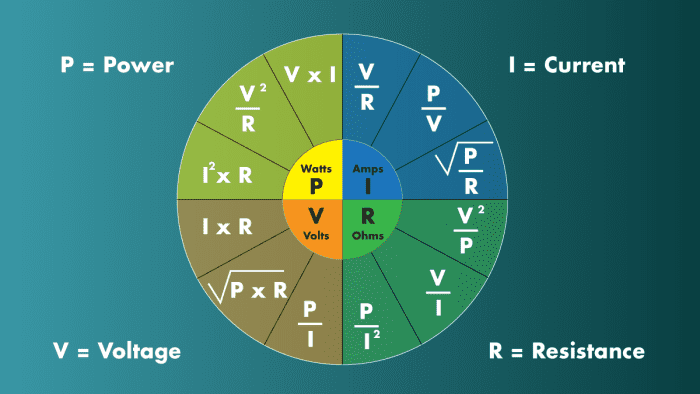
Formulae circle for solving electrical unit of measurement equations.
In Conclusion
Subsequently reading this article, you hopefully have a better agreement of the divergence between electric current, voltage, resistance, and electrical power. Recall that if y'all know whatever two of the physical values in the formulae circle then you can calculate each of the other 2 unknown values.
Basic Electricity Tutorial (Video)
Electricity Quiz
For each question, choose the all-time answer. The answer key is below.
- If I connect a 120V supply to a 60W bulb, what current would flow in the excursion?
- 1A
- 2A
- 0.5A
- 5A
- If a 3V battery is connected to a bulb and a current of 1.5A flows through it so what is the rating of the bulb?
- 3W
- 2W
- four.5W
- 0.5W
Respond Key
- 0.5A
- 4.5W
Interpreting Your Score
If you lot got 0 correct answers: Maybe you lot need to reread this article?
If you got 1 correct answer: Do you run across where you went wrong?
If you lot got 2 right answers: Well done. You certainly know Watt is Watt!
Questions & Answers
Question: What is the resistance of the heating chemical element of an electric iron if the ampere describe is 8 amperes when 115 volts are applied?
Answer: R= 5/I = 115/viii = 14.four Amps
Question: Can I run ii appliances at the aforementioned fourth dimension when the max amps bachelor is 5A? One requires three amp, and the other requires 4.15 amp.
Answer: The answer is no. The total current fatigued is 7.15 Amps. This would overload a 5A socket, and result in a 5A fuse blowing or a 5A excursion billow being triggered.
© 2009 Rik Ravado
Robert on May 26, 2020:
Very informative and helpful.
James Watt on April 23, 2020:
"and Watts are named after Scottish inventor and mathematician James Watt"
Dennis on April 09, 2020:
Very useful, insight
CR7 on March 24, 2020:
Blurry images
Rooprick on November 22, 2019:
I'thousand trying to attach a cork to my Fork so when I swallow I don't hurt myself or others how do I do that
brit on November 21, 2019:
cool
Branson on September 24, 2019:
I am trying to design a battery power led light strip. My question is if my led controller is 12v, what amperage 12v battery supply can I use? 2A? 4A? 6A?
remlalnghaka on September 21, 2019:
very interesting
Rahimullah Sahak on August 02, 2019:
hi love thinks for your skilful and a all-time incarnation I have 1 question what is the spicefication of wire and his color and his cade
ubaid on July 31, 2019:
how much units volition be comsumed past an electronic device of 3 amps per 60 minutes
manivannan on July eighteen, 2019:
thaks to all informations
Ghulab hameed on May 15, 2019:
sir plz tell me how nosotros know a device how many voltage applied and which condination will be show?
Krystal on May 14, 2019:
Trying to get the answer to this question can anybody help me please need if by the moring for school
ane. Question:
I=.5amps,R=50phms,P=
Heidy on April 01, 2019:
thanks for explaining the basics of electricity. It brand sense now
Asitya on March 20, 2019:
Overnice information technology's and then easy
COOPER IS SIMPLE on February eleven, 2019:
Cooper said he's being uncomplicated but he'due south using highly unnecessary "large" words and it is stupidly just abrasive.
robert cannon on January 21, 2019:
I don't intendance nearly small-scale electric quiz I what one question answered what gauge wire is needed to claw up a welder rated at 230 volts 220 amps as far as I got as it is with electricity is this high a amperage volition impale you
Aamir on January 17, 2019:
very well explained.
yoyo on Nov 05, 2018:
thanks !..it was interesting.
Cooper on October xxx, 2018:
So we know plugging an extension into some other extension (and having load being drawn from said setup) will (mayhap) hit the maximum immune Amperage/Wattage for that extension and burn it out...
But we can have multiple devices like Fridges, Freezers, Television'due south, Irons, etc, etc... Each on their own "Plug Socket" simply aren't the Plug Sockets essentially simply 'extensions' of the house Mains? -
Presuming my respond is probably bachelor on the house's Principal Fuse Board?... I'm curious to ask how one would calculate the Maximum Potential Amperage & Wattage load of 1's entire house!
I know I could add upwards all my devices and calculate 'My Specific Total Depict' but how much further 'til I hit the 'maximum for my residence'?
The answer is probably stupidly simple, but I'1000 being stupidly unproblematic at the moment then such an reply would be warranted :D
- Cooper
Sanju pradhan on October 18, 2018:
It'due south very helpful to me for my studies.
Oh ya daddy on October 10, 2018:
Thanks helpful
Liam on Oct 05, 2018:
Very Interesting, thankyou!
hi babe on July 03, 2018:
very practiced and very helpful
Brunsrm on Apr 02, 2018:
Can I run 2 appliances at the same time when the max electrical provided is 5 amps? One requires 4.12 A and the other requires 3 A.
Thanks for your help
Taylor on March 27, 2018:
I had to do a speech on inventions that changed the quality of life. I chose electricity. This website helped.
Prabhjot on March 17, 2018:
Cheers a lot for teaching u.s. in easy ways so we could sympathize thanks :)
Hendrik on February 25, 2018:
Ω my god, 31 years old and finally sympathize the nuts!
Gabe on February 23, 2018:
This make me understand how does volts and wats work. Before i cant practice the difference betwixt volts and watts.
I love Yucheng Jade Shao on Jan 23, 2018:
This was an astonishing presentation and it helped me alot to empathise volts, Amps, Ohms, and Watts!
David on January xv, 2018:
This is an excellent video that I highly recommend for all beginners like me. I now have a good bones understanding of how electricity works in our everyday world. Give thanks you!
ramesh kumar verma on Jan 01, 2018:
pleas help me how sympathize electricity ie wattage, volts and amps, how to increase amps & decrease in the circuit
a random guy on December 15, 2017:
a skele-TON of data, thanks.
a random guy on December 15, 2017:
this helped a lot
toby on November 10, 2017:
Examples used in teaching were the all-time i read so far.Cheers so much :)
Esmaeel on October 30, 2017:
It's really an added value
zulfiqar Ahmad on October 25, 2017:
Very squeamish
S Kanda on October 21, 2017:
It helped me to understand electricity ie wattage, volts and amps, better than books.
D.bong on October 04, 2017:
This helped a lot cheers
mehul lavri on September 26, 2017:
good presentation
asif javed on September 12, 2017:
vivid description about electricity
J. R. on September 08, 2017:
Very skillful presentation
andrea Sherman on September 04, 2017:
I never understood how that worked. I still am sort of confused . isn't electricity measured in both particles and linear?. I took a class chosen physics for poets about 40 years ago. thanks✌
@Jeet on August 29, 2017:
Very useful thanks.
Meseret Yirdaw on May 25, 2017:
That is very nice.I would like to thank more and more.Keep it up.
Ashfaq on May 24, 2017:
Very helpful page regarding understand of elementary electricity
Harpal Singh on May 15, 2017:
Astonishing.....Honestly speaking this is the first time i fully understood it...
thks....
kira on May 03, 2017:
i really notice it interesting while reading this,and I learnt alot,thanks anybody for contributing to this.
Chethan shetty on April 13, 2017:
Helps to understand even for mechanical students
Sandip Deb gupta on March 23, 2017:
It's very practiced article wonderful experience
Nope on March 08, 2017:
Thanks
Rizwan on Jan 22, 2017:
Nice explanation
DILLI SAHU on January 22, 2017:
Thank yous Sir,
Nice north simple caption of current, volt and watt.
lavysay on January 05, 2017:
absurd
Nancy Marine on Oct 03, 2016:
I got 2/ii of the question, I guess I know watt is watt.
ade on October 03, 2016:
amazing, never been able to become this stuff in my Head and y'all've managed it so succinctly mate, thanks ever so much, Cheers
jeo on September sixteen, 2016:
hullo there, i am merely getting to know about electricity. and has always been dislocated to hell, what is Amps, Volts etc. now i understood it all.
thank you for the article. God Bless
SAQIB from HYDERABAD Islamic republic of pakistan on January 29, 2015:
Being engineer myself I enjoyed reading the concepts.
sanjay on December 19, 2014:
Very skilful
MARJ WATSON on July 26, 2014:
Please suggest this old lady if I can use Gu10 replacement bulbs with 110/220 in the uk, as I bought them in mistake, thanking you in anticipation,
Marj
Someone on March 08, 2014:
That was useful thank you
santosh kumar on January 20, 2014:
Thanks a lot for your wonderful particular explainatin. I hope information technology would be very helpful to all beginers. All-time wishes for your blog.
Alpo on January 05, 2014:
Cheers for the tutorial...it has been awhile and was looking for the basic equations. Co-ordinate to your article, "A" is short for amperes or amps. Later, "I" is introduced without relating it to amps. For clarity, yous might add together that.
vikas pal on September 10, 2013:
great web log
Alex on May 22, 2013:
Can someone help to find out 12 volt ??? west required in the given satiation?
I required 220 volt 1000 west to run my awarding. i am planning to install solar panel to have total fill up my requirement. it involve solar panel ,12 volt bombardment, and ability inverter, how many watts of 12 volt panel do i required to have 220 volt 1000w power to run my application
Rusty on April 09, 2013:
I found it interesting that elkangorito said no way 120 is safer than 230 volts. And so why in England on ALL commercial work sites the max voltage used is 120? Everything is stepped down from 230 to 120.
Cheers
Kiran Chandran on October 04, 2012:
I had cleared many doubts past using this........
amped on July 17, 2012:
Very useful explanation.
saratchandra on May 25, 2012:
Good explanation with examples
ajay on April xvi, 2012:
thanks for the answer. sir please give one more answer about transformers. I read somewhere that transformers can increase and decrease the voltage of a said line, so in that case is it possible to decrease the incomming 220v primary line of my house to say 24v and then again increase information technology 220v for normal usage. will the functioning exist the same and will information technology decrease the electric beak.
Rik Ravado (author) from England on April 14, 2012:
ajay - the maximum current would depend on the fuse or breaker in the circuit. In theory, if you curt circuited the 120v you lot could go an space current but domestic supplies normally have a breaker that trips if you depict besides much current. In the U.k., our domestic circuits typically allow you to draw about 13A from a three pivot plug only information technology my exist college elsewhere, for example the U.s..
ajay on April 14, 2012:
how do we determine the maximum limit of ampereage that tin be drawn out of a 120 volts line
Ak on December 28, 2011:
Thanks for the heads-up Rik. I want to implement inexpensive renewable free energy, could you outline few options? Pv or solar panels are not the options where i alive. I heard a lot about fuel cells, are they expensive?
Rik Ravado (author) from England on Dec 22, 2011:
Ak - These products are all scams. You don't become electric free energy for nothing. You can convert mechanical energy into electrical free energy, a generator does this. Merely yous still take to put the same corporeality of energy in. Scammers sometimes talk nigh perpetual motion in connexion with free free energy but it doesn't exist.
Ak on December 21, 2011:
I have a question.. Can the magnetic free energy be converted to electric enegergy somehow by properly placing them on a flywheel? Rotating the flywheel using the magnetic force. At that place are lot of things going on the web about it. And how come they only sell guides but non the finished product.
Ak on December 21, 2011:
Clear as crystal
Robert on Dec 18, 2011:
First, thanks does not say enough for this. I am a slow learner and frontwards to using this to help learn virtually electricity. I am finding out that it is not that hard, but like Bert Thousand commented, U+P=R. Thank you again so much Mr. Ravado
Rik Ravado (author) from England on Nov 11, 2011:
Brett
Well spotted - I agree. (Changed the graphic) Cheers!
Brett on November 10, 2011:
Shouldn't your graphic read I = sqrt(P) / R instead of I = sqrt(P) / Five?
Rik Ravado (author) from England on March 12, 2011:
Thanks for the feedback Bert - you lot are so right with U+P=R.
Learning is much more constructive when you put what yous have learned into practice!
bert chiliad on March 12, 2011:
thanks for the gratis lesson. you made information technology very articulate and easy to sympathise. here is a smart formula i'd like to laissez passer on to beginners similar myself. U+P=R or utilization plus exercise equals retentiveness. i wish there had been internet and google when i was a kid. all-time regards teach. bk
topquark from Great britain on February 07, 2011:
Useful and well-presented article! A lot of people seem to get dislocated nigh Watts and Amps and Volts - an explanation like this has been long overdue.
bernie on October 12, 2010:
Everyones a cridic. I understood completely and I understood that information technology is not on the money, and those of us who don't have to act like know it all's realize that in that location are factors involved that makes the math shut, but there is room for error. Maybe thicknees of the wire being used, battery losing power, or whatever the reason. People chill!!! If I understood and realise this and so you brain childeren should. Anal Bastards.
Kevin on October 03, 2010:
Thank you for this mate.
Helped a lot with my schoolwork. :P
Rik Ravado (author) from England on June 09, 2010:
Thanks Peter!
Peter Enmore on June 08, 2010:
Aye, you actually can't go the adding it to an verbal. Simply you can definitely get an approximate.
Rik Ravado (author) from England on February 06, 2010:
Elk
Thanks for your comments - I notwithstanding maintain 120v is safer than 230v. In other words the lower the voltage, the less current potentially flows through the victim.
I agree with your 'approximately' as evidently cable and other elements in the circuit will further lower the current. Besides the rating of the bulb or other appliance volition not be precise and there will be a margin of fault.
Thanks for stopping past and commenting!
elkangorito from Thailand on February 06, 2010:
Fifty-fifty though your blog is an excellent "guide to the basics of electricity", in that location are a couple of things that need to be considered:
You lot said, "In the USA, the domestic supply is typically 110V, much safer than the United kingdom."
This is not truthful.
Firstly, the voltage in the UK is officially 230v (single phase, domestic).
Secondly, the voltage in the USA is 120v (domestic).
120v is in no way "safer" than 230v. A "prophylactic" voltage is considered to be less than 50v RMS (Ac) or 120v DC (ripple costless). These voltages are known as "actress low voltages" & relate to "touch voltage limits".
You as well said: "Finally, call up that if you know the voltage of your ability supply then you lot can calculate the electric current through a bulb, fuse or other electrical appliance or component, based on its rating in Watts."
I think that you meant to say, "Finally, recollect that if yous know the voltage of your power supply then yous tin APPROXIMATELY calculate the current through a seedling, fuse or other electric apparatus or component, based on its rating in Watts."
Rik Ravado (author) from England on November 04, 2009:
LiamBean - glad you establish information technology helpful!
LiamBean from Los Angeles, Calilfornia on October 23, 2009:
Lovely. Wonderful explanation of Watts, Amps, and Current.

Source: https://owlcation.com/stem/Watt-are-Amps-and-Volts
Posted by: boydflid1954.blogspot.com
0 Response to "When Do You Need A 200 Amp Service"
Post a Comment